

For discerning luxury hospitality brands, establishing a distinct and memorable identity is paramount. Your brand is more than just a logo; it embodies the entire guest experience, from the moment they discover you to the lasting memories they carry. When it comes to cultivating this crucial identity, a fundamental question often arises: should you build your brand using an in-house team, or partner with an external branding agency? The decision isn’t always straightforward, and both approaches offer unique advantages and challenges.
Choosing the right path for your luxury hotel, resort, or exclusive service brand impacts everything from creative vision to long-term market position. It involves weighing control, cost, expertise, and efficiency against your specific business goals and operational structure. This article delves deep into the nuances of in-house versus agency branding for the sophisticated world of luxury hospitality, helping you make an informed choice that elevates your brand to new heights.
The Short Answer: In-House vs. Agency At A Glance
While a definitive “best” option doesn’t exist without understanding your specific context, here’s a quick comparison of the core differences between managing your luxury hospitality branding in-house versus engaging an agency:
- Control & Brand Stewardship:
- In-House: Offers maximum direct control, fostering deep brand immersion and consistent messaging directly from the core business.
- Agency: Involves delegating creative and strategic control, with oversight, bringing external expertise and objectivity.
- Expertise & Perspective:
- In-House: Deep, niche understanding of your specific brand culture and operational intricacies; however, expertise might be limited to the hired team’s skill set.
- Agency: Access to diverse, specialized talents and broader industry insights, offering fresh perspectives and experience across various luxury brands.
- Cost Structure:
- In-House: Fixed salaries, benefits, operational overheads, and potential recruitment costs; long-term investment.
- Agency: Project-based fees or retainers, often higher upfront, but can be more flexible and scalable without permanent overhead.
- Speed & Scalability:
- In-House: Can be slower to scale up for large projects due to hiring/training, but day-to-day work can be agile.
- Agency: Rapid deployment of resources for specific projects, offering scalability for varying demands without increasing your permanent headcount.
- Innovation & Trends:
- In-House: Relies on internal research and development, potentially slower to adapt to rapid market shifts.
- Agency: Often at the forefront of trends, technology, and innovative strategies due to their work with multiple clients and market exposure.
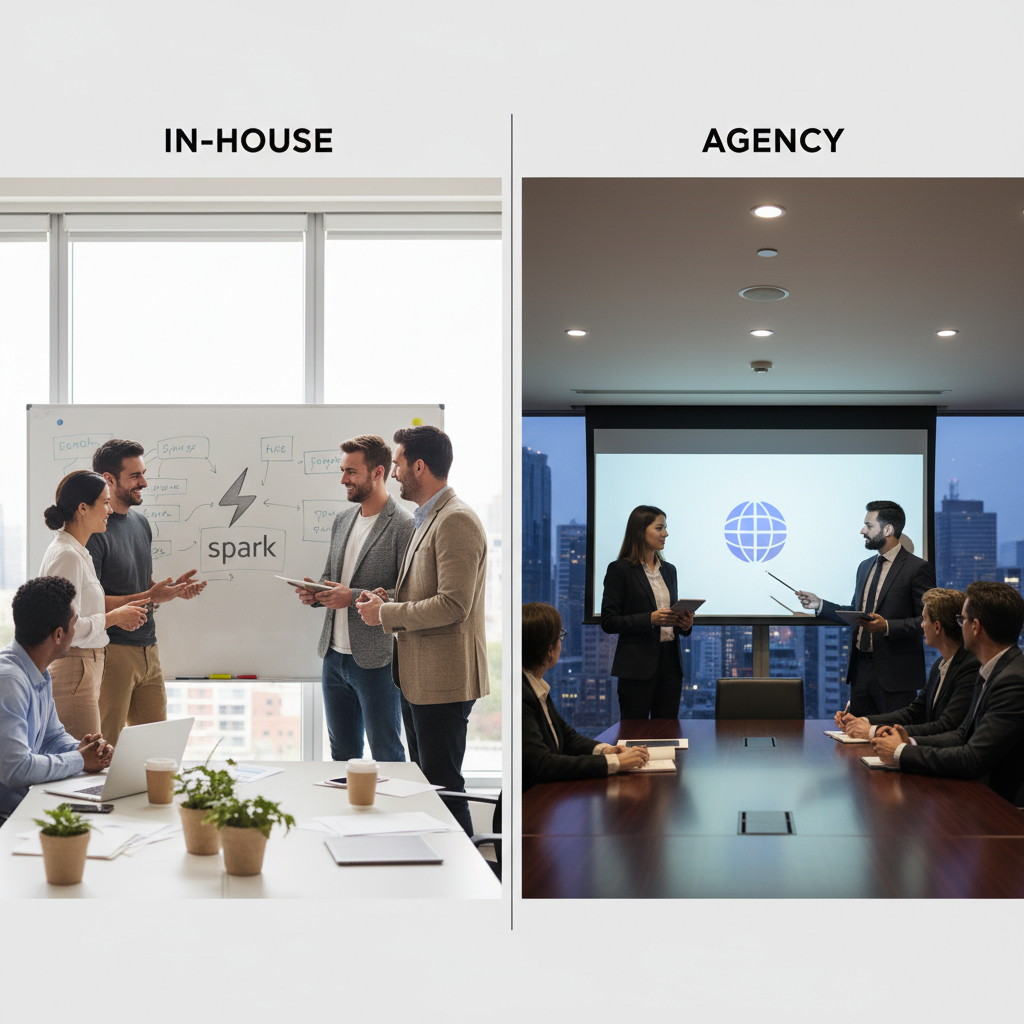
What Is In-House Branding And When Does It Shine?
In-house branding refers to the practice of building and managing your brand’s identity, marketing, and communication efforts using an internal team of employees. This team typically consists of designers, copywriters, strategists, and marketing specialists who are fully dedicated to your brand’s vision.
Benefits of In-House Branding for Luxury Hospitality:
- Deep Brand Immersion: Your in-house team lives and breathes your brand every day. They develop an unparalleled understanding of your property’s unique culture, values, guest demographics, and operational nuances. This deep immersion ensures authenticity in all branding efforts.
- Consistent Vision: With a dedicated internal team, maintaining a consistent brand voice, visual identity, and messaging across all touchpoints becomes more manageable. There are fewer external interpretations or miscommunications, leading to a cohesive brand narrative.
- Direct Control and Agility: You have immediate and direct control over all creative and strategic decisions. This allows for quick adjustments, rapid responses to market changes, and seamless integration with other internal departments, such as operations and guest relations.
- Cost-Effectiveness (Long-Term): While initial setup costs (salaries, benefits, tools) can be significant, an in-house team can prove more cost-effective over the long term, especially if your branding needs are ongoing and extensive. You avoid per-project agency fees.
- Proprietary Knowledge Retention: All brand-specific insights, strategies, and intellectual property remain within your organization, building valuable institutional knowledge over time.
When To Choose In-House Branding:
An in-house approach often excels under specific conditions:
- Established Brands with Unique Culture: If your luxury property has a long history, a deeply embedded brand culture, or a very specific niche that requires nuanced understanding, an in-house team can best preserve and evolve that identity.
- Consistent, Ongoing Branding Needs: Brands with continuous content creation, regular campaign launches, and evolving marketing demands might find an in-house team more efficient than constantly engaging external agencies for every piece of work.
- Sufficient Budget for Staffing: You have the financial resources to attract, hire, and retain top-tier branding professionals with competitive salaries and benefits.
- Desire for Absolute Control: If maintaining complete creative and strategic control without external input is a non-negotiable priority, an in-house team is the ideal choice.
- Strong Internal Leadership: A clear, visionary leader capable of directing and motivating a creative team is essential for in-house success.

What Is Agency Branding And When Does It Win?
Agency branding involves partnering with an external firm specializing in brand strategy, design, and marketing. These agencies bring a team of diverse experts-from market researchers and strategists to graphic designers, copywriters, and digital marketers-to work on your brand, typically on a project-by-project basis or under a retainer agreement.
Benefits of Agency Branding for Luxury Hospitality:
- Diverse and Specialized Expertise: Agencies house a wide array of specialists, offering deep expertise in areas like market research, brand positioning, luxury design, digital marketing, and reputation management. This breadth of knowledge is hard to replicate with a small in-house team.
- Fresh Perspective & Objectivity: An external agency brings an unbiased, outside-in view of your brand and the competitive landscape. They can identify opportunities or challenges that internal teams, too close to the brand, might overlook. This is invaluable for innovative brand development.
- Scalability and Flexibility: Agencies can quickly scale up or down resources based on your project’s demands. Whether it’s a major re-branding initiative or a specific campaign, they can allocate the necessary talent without you needing to hire permanent staff.
- Access to Latest Tools & Trends: Agencies often invest heavily in cutting-edge software, market research tools, and staying abreast of the latest industry trends and technologies. This ensures your brand benefits from the most current and effective strategies.
- Efficiency and Speed: With established processes and dedicated project management, agencies can often execute branding projects more efficiently and within tighter deadlines, especially for complex or multi-faceted campaigns.
- Reduced Overhead: You pay for specific services or projects, avoiding the long-term costs associated with salaries, benefits, training, and equipment for an in-house team.
When To Choose Agency Branding:
Engaging an agency is often the superior choice in these situations:
- New Brand Launches or Re-branding: For launching a new luxury property or undertaking a complete brand overhaul, an agency’s strategic prowess and creative firepower can define your success.
- Specific, Project-Based Needs: If you require expertise for a particular campaign-like a new loyalty program launch, digital experience design, or a specific design solution-an agency can be brought in for that defined scope.
- Limited Internal Resources: If your current team lacks the specialized skills, time, or capacity to manage comprehensive branding initiatives, an agency fills that gap effectively.
- Seeking Innovation and Disruption: For brands looking to break new ground, challenge norms, or introduce highly creative concepts, an agency’s diverse portfolio and forward-thinking approach can be a significant asset. You can explore our portfolio to see examples of innovative solutions.
- Competitive Market Entry: When entering a highly competitive luxury market, an agency’s experience in crafting compelling differentiators and strategic positioning can be crucial for standing out.
- Need for External Validation: An agency’s professional insights and market research can provide valuable external validation for your brand strategy.

How Fit Changes The Decision
The “best” choice for your luxury hospitality brand isn’t about one option being inherently superior, but about which one provides the best fit for your unique circumstances. Consider these factors when making your decision:
- Your Brand’s Stage and Size: A start-up luxury boutique hotel might benefit more from an agency’s comprehensive services, while a multinational luxury hotel chain with extensive resources might lean towards a hybrid model or robust in-house team.
- Budget and Financial Model: Clearly define your budget. Are you prepared for the ongoing, fixed costs of an internal team, or do you prefer project-based investments with an agency? Factor in not just salaries, but also tools, software, training, and recruitment costs for in-house.
- Strategic Goals and Timelines: What do you want to achieve, and by when? If you need a rapid, high-impact re-brand, an agency is often faster. If your goal is slow, organic brand evolution with deep internal consistency, in-house might be preferred.
- Internal Capabilities & Gaps: Honestly assess your existing team’s skills. Do you have a strong marketing director but lack design expertise? Are you strong in digital but weak in traditional brand storytelling? An agency can fill specific skill gaps without permanent hiring.
- Culture and Values: Does your organization thrive on internal collaboration and hands-on control, or are you comfortable delegating to external partners who align with your values? The cultural fit with an agency is as important as their capabilities.
A hybrid approach is also increasingly popular, where a core in-house team manages daily branding, while agencies are brought in for specialized projects, major campaigns, or to provide fresh strategic insights. This blend can offer the best of both worlds.
Real Life Scenarios
The Emerging Boutique Hotel with a Unique Concept
Imagine a new, avant-garde luxury boutique hotel opening in a vibrant urban center. They have a compelling vision for their guest experience but limited internal marketing resources. In this scenario, partnering with a specialized branding agency would be highly advantageous. The agency could help them define their brand narrative, create a distinctive visual identity, develop a compelling digital presence, and launch with maximum impact. Their fresh perspective and experience with market entry would be invaluable.
The Established Luxury Resort Chain Seeking Digital Transformation
Consider a well-established luxury resort chain with multiple properties globally. They have a strong in-house marketing department handling day-to-day operations and brand consistency. However, they recognize a need to significantly upgrade their digital guest experience, from online booking to personalized in-stay communication, and perhaps explore marketing solutions for a younger demographic. Here, a hybrid approach shines. The in-house team maintains core brand integrity, while an agency specializing in luxury digital experiences and tech innovation is brought in for a defined project to spearhead this transformation, bringing specialized skills that might not exist internally.
The Exclusive Private Members’ Club Re-aligning Its Core Values
An elite, long-standing private members’ club wishes to re-evaluate and re-articulate its core values to attract a new generation of members while retaining its heritage. This is a highly sensitive project requiring deep historical understanding and a delicate touch. An in-house team, with their intimate knowledge of the club’s history, membership, and traditions, would be best positioned to lead this internal reflection. They could then engage an agency for specific creative execution-like a new visual identity or updated communication materials-once the core strategic direction is firmly established internally, ensuring the authenticity remains intact.
Common Myths About Luxury Hospitality Branding
- Myth 1: In-house is always cheaper than an agency. Reality: While an in-house team avoids agency fees, the true cost includes salaries, benefits, office space, software licenses, training, and the significant hidden cost of recruitment. If you only need occasional branding work or highly specialized skills, an agency can be more cost-effective. The opportunity cost of an internal team managing tasks an agency could do faster and better should also be considered.
- Myth 2: Agencies don’t truly understand our brand. Reality: Reputable luxury branding agencies invest heavily in understanding their clients. Through intensive discovery sessions, market research, competitor analysis, and deep dives into your property’s operations and guest profiles, they strive to become brand stewards. Their external perspective can even highlight nuances you’re too close to see.
- Myth 3: In-house means faster execution. Reality: While direct communication is a benefit, internal teams can be bogged down by company politics, other priorities, or limited resources. Agencies, especially those with robust project management, are designed for efficiency and can often deliver complex projects on tighter deadlines by dedicating a full team to your work.
- Myth 4: Agencies only work with large, established brands. Reality: Many agencies cater to a range of businesses, from nascent luxury start-ups to boutique hotels, offering scalable services. In fact, newer brands often benefit most from an agency’s strategic guidance in establishing their initial market presence.
- Myth 5: You lose control with an agency. Reality: A good agency relationship is a partnership. You maintain strategic oversight and approval at every stage. The agency serves as an extension of your team, executing your vision with their specialized skills, not taking over your brand entirely.
So… In-House Or Agency?
The decision between in-house and agency branding for your luxury hospitality venture is a strategic one, deeply intertwined with your brand’s unique identity, resources, and aspirations. There’s no one-size-fits-all answer, but rather a journey of careful consideration.
If your luxury property thrives on deep internal cultural understanding, consistent long-term execution, and you possess the resources to build and nurture a top-tier internal team, an in-house approach could be your ideal fit. It offers unparalleled control and brand immersion.
However, if your needs lean towards specialized expertise, fresh perspectives, rapid scalability, innovation, or you require significant impact for a new launch or re-branding, partnering with an experienced agency like AXAR can be transformative. They bring a wealth of diverse talent and market insights to the table.
Ultimately, the most effective solution might be a dynamic hybrid model, leveraging the strengths of both. A lean in-house team can steer the brand’s core vision and day-to-day needs, while agencies are strategically engaged for their specialized prowess on high-impact projects or to infuse new energy. Whichever path you choose, ensuring clarity of vision, robust communication, and a commitment to unparalleled guest experience will be the true hallmarks of your luxury hospitality brand’s success. If you’re ready to discuss your branding needs, feel free to contact us.
Sources
- Branding – Wikipedia
- Hospitality industry – Wikipedia
- E-commerce – Wikipedia
- Marketing – Harvard Business Review
FAQ
Q: What is the primary advantage of in-house branding for luxury hospitality?
A: The primary advantage is unparalleled brand immersion and control. An in-house team deeply understands your unique luxury property’s culture, values, and operational nuances, leading to highly authentic and consistent brand messaging.
Q: When should a luxury hospitality brand definitely consider an agency?
A: A luxury hospitality brand should strongly consider an agency for new property launches, comprehensive re-branding initiatives, when seeking fresh external perspectives, or when needing highly specialized skills (e.g., luxury digital experience design) that are not present in-house.
Q: Is a hybrid approach common in luxury hospitality branding?
A: Yes, a hybrid approach is increasingly common and often highly effective. It allows a luxury brand to maintain a core in-house team for daily consistency while engaging agencies for specific, high-impact projects, specialized expertise, or to introduce innovative strategies.
Q: How can I ensure an agency truly understands my luxury brand’s unique identity?
A: To ensure deep understanding, engage in thorough discovery sessions with potential agencies. Provide them with extensive brand guidelines, historical context, guest profiles, and access to key stakeholders. A strong agency will actively listen, research, and demonstrate their grasp of your brand’s essence through their proposals and initial concepts.
Q: What are the key cost differences between in-house and agency branding?
A: In-house involves fixed, ongoing costs like salaries, benefits, and operational overheads, which can be significant long-term investments. Agency costs are typically project-based fees or retainers, which can be higher upfront for specific campaigns but offer flexibility without permanent employment overheads. It’s crucial to consider total cost of ownership and not just direct fees.