

For premium brands in the highly competitive cruise and food & beverage (FnB) sectors, distinctive brand design isn’t just an aesthetic choice-it’s a critical business imperative. It shapes perceptions, drives loyalty, and communicates the essence of exclusivity. Yet, a fundamental question often arises for leaders: should we cultivate an in-house design team or partner with a specialized external agency?
This decision, laden with implications for creativity, cost, control, and strategic alignment, can feel daunting. Both approaches offer unique advantages and potential drawbacks. Understanding which path best suits your luxury cruise line or FnB venture requires a deep dive into their respective structures, benefits, and how they align with your specific goals. At AXAR, we understand these complexities and aim to illuminate the factors that will guide your choice, ensuring your brand achieves unparalleled elegance and market resonance.
The Short Answer: In-House vs. Agency At A Glance
Choosing between an in-house design team and an external agency involves weighing various factors crucial for luxury brand success. Here’s a quick comparison of their fundamental differences, helping you understand their core propositions before a deeper dive.
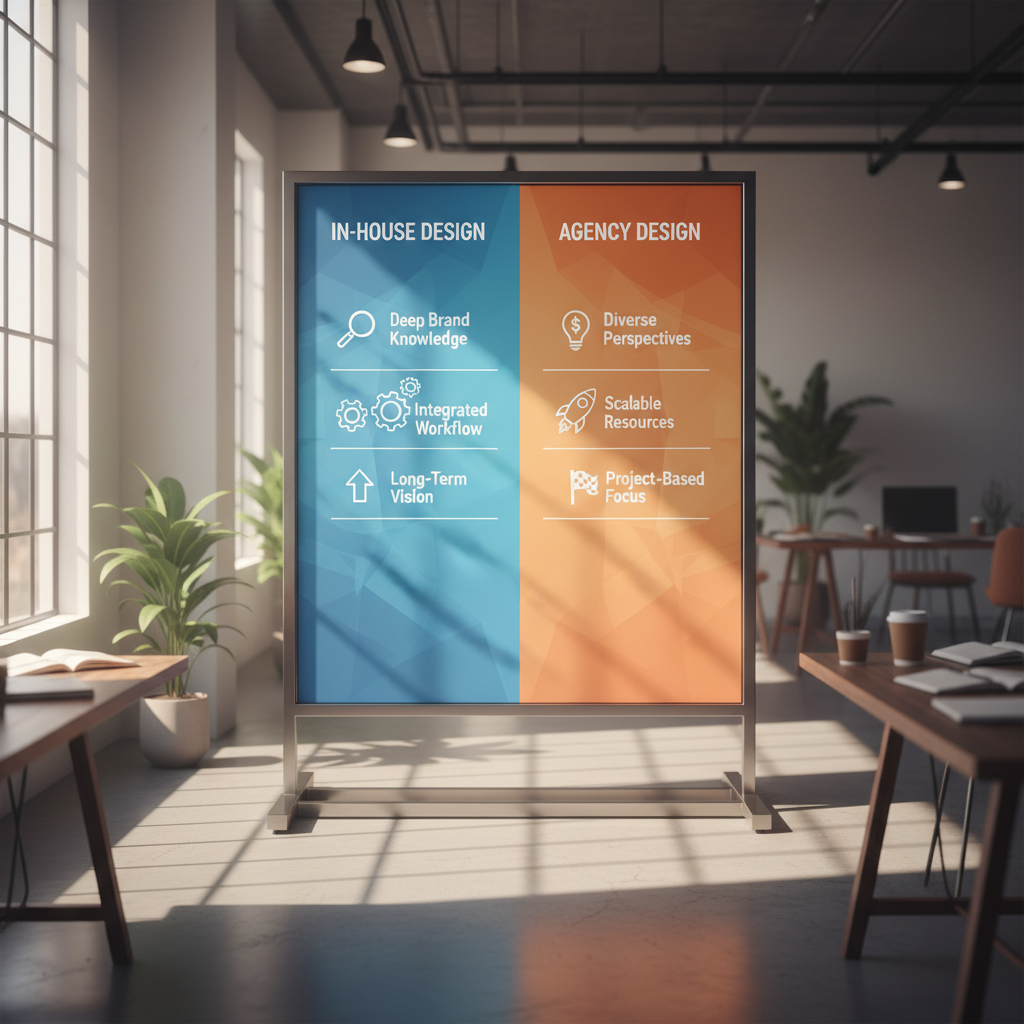
In-House Team
- Brand Immersion: Deep, continuous understanding of company culture, values, and long-term vision.
- Control & Consistency: Maximum direct control over creative direction and brand messaging, ensuring strict adherence to guidelines.
- Communication: Immediate and constant internal feedback loops, fostering seamless collaboration with other departments.
- Cost Structure: Fixed salaries and benefits, predictable but potentially higher overhead for specific, infrequent projects.
- Expertise Focus: Specialized in the specific brand’s niche, developing profound category knowledge over time.
- Speed & Agility: Quicker turnaround for routine tasks and minor adjustments due to proximity and familiarity.
External Agency
- Diverse Perspectives: Brings a breadth of experience from various industries and clients, offering fresh, innovative insights.
- Specialized Expertise: Access to a wide array of specialized skills (e.g., UI/UX, motion graphics, specific luxury materials) that might be costly to maintain in-house.
- Scalability: Easily scale resources up or down based on project needs, avoiding permanent staffing costs.
- Objectivity: Provides an unbiased, external viewpoint, challenging assumptions and pushing creative boundaries.
- Cost Structure: Project-based or retainer fees, potentially higher per-project cost but no long-term employment overhead.
- Network & Resources: Access to broader industry networks, trends, and cutting-edge tools and technologies.
What Is In-House Design And When Does It Shine?
An in-house design team consists of creative professionals directly employed by your company, working exclusively on your brand’s projects. These individuals are an integral part of your organizational structure, often collaborating closely with marketing, product development, and executive leadership. Their daily presence within your company fosters a unique level of brand intimacy and operational alignment.
Benefits of In-House Design
- Unmatched Brand Guardianship: An in-house team lives and breathes your brand. They possess an unparalleled understanding of your heritage, values, and future aspirations, ensuring every design decision is deeply rooted in your brand’s DNA. This continuous immersion minimizes the risk of misinterpretation often associated with external partners.
- Seamless Communication & Collaboration: Proximity facilitates instant communication. Designers can easily engage with other departments-from the culinary team discussing menu aesthetics to operations defining interior design elements for a new cruise ship. This fluidity leads to faster decision-making and a more integrated brand experience.
- Consistent Brand Voice: With a singular team focused solely on your brand, maintaining a cohesive visual and verbal identity across all touchpoints becomes more manageable. This is crucial for luxury brands where consistency directly translates to trust and perceived value.
- Long-Term Strategic Alignment: In-house teams are invested in your company’s long-term vision. They can develop design strategies that evolve with the brand, providing continuous support and adaptation rather than a series of project-based engagements.
- Cost Predictability (Long-Term): While initial setup costs can be significant, the ongoing costs of an in-house team are typically fixed salaries and benefits, offering predictable budgeting once established.
When To Choose In-House Design for Luxury Cruise & FnB
An in-house team truly shines when:
- You Require Absolute Brand Control: For highly established luxury brands with deeply ingrained identities, maintaining complete creative control is paramount. An in-house team ensures every nuance is handled with internal oversight.
- Design Needs Are Constant & Varied: If your brand consistently requires a wide range of design work-from daily social media content and promotional materials to menu updates, uniform designs, and ship interior refreshes-an in-house team can provide continuous, on-demand support.
- Confidentiality Is Key: For new product launches, exclusive partnerships, or sensitive rebranding efforts, an in-house team offers a higher degree of confidentiality and data security.
- You Have a Robust Internal Culture: Brands with a strong, supportive internal culture and a clear strategic vision can effectively integrate and empower an in-house design department.
What Is Agency Design And When Does It Win?
A design agency is an independent company specializing in creative services, working with multiple clients across various industries. Agencies bring together diverse talents-from strategists and graphic designers to copywriters, photographers, and digital specialists-offering a comprehensive suite of solutions. They operate on a project-by-project basis or through long-term retainers, bringing external expertise to your specific challenges.
Benefits of Agency Design
- Diverse Expertise & Fresh Perspectives: Agencies constantly work on different brands and projects, exposing them to a vast array of challenges and solutions. This breadth of experience allows them to bring fresh, innovative ideas and best practices from various sectors directly to your luxury brand, preventing creative stagnation. For more about this, see the E-commerce – Wikipedia.
- Scalability & Flexibility: One of the most significant advantages is the ability to scale resources up or down as needed. Launching a new cruise line requires a massive, coordinated design effort; a smaller seasonal menu update for an FnB outlet might not. An agency can assemble the perfect team for any scope, without you incurring permanent overhead.
- Access to Specialized Skills: Luxury branding often demands highly specialized skills-think bespoke typography, intricate packaging design, experiential marketing, or high-end photography. Agencies typically house these specialized experts, which would be prohibitively expensive to maintain in a full-time in-house team.
- Objectivity & External Validation: An agency provides an unbiased, external viewpoint. They can challenge internal assumptions, offer critical insights, and push creative boundaries in ways an internal team, deeply embedded in the company culture, might find difficult. This objectivity can be invaluable for groundbreaking projects.
- Cost Efficiency (Project-Based): While agency fees can appear higher per project, they eliminate the fixed costs of salaries, benefits, office space, software licenses, and training for full-time employees. You pay for specific outcomes, making it highly efficient for defined projects.
When To Choose Agency Design for Luxury Cruise & FnB
An external agency becomes the optimal choice when:
- Launching New Ventures or Major Rebranding: For a new luxury cruise brand launch or a complete overhaul of an existing FnB identity, an agency can provide the intensive, multi-disciplinary creative firepower required to make a significant market impact quickly and effectively.
- Seeking Fresh, Disruptive Ideas: If your brand is looking to break new ground, stand out in a crowded market, or needs a creative injection that challenges the status quo, an agency’s external perspective can be transformative.
- Specific, Time-Bound Projects: For defined projects with clear deliverables-such as designing a new set of luxury amenities for a cruise suite, developing a limited-edition menu concept, or crafting a campaign for a seasonal event-an agency offers focused expertise without long-term commitment.
- Budgeting for Outcomes: If your financial strategy favors project-based spending over fixed departmental overhead, an agency model aligns well with controlled, outcome-driven investments.

How Fit Changes The Decision
The choice between in-house and agency isn’t simply about capabilities; it’s profoundly about fit-how each option aligns with your organization’s unique structure, culture, and strategic priorities. Consider these critical factors:
- Budget & Financial Philosophy: Do you prefer predictable fixed costs (in-house) or project-based investments with variable outlays (agency)? Luxury brands often have substantial budgets, but how those funds are allocated for creative services makes a difference.
- Project Scope & Frequency: A steady stream of diverse design needs often points to in-house, whereas sporadic, large-scale, or highly specialized projects benefit from an agency’s scalable resources.
- Company Culture: Is your organization hierarchical or collaborative? Does it value deep internal relationships or external partnerships for innovation? A company that thrives on internal cohesion might find an in-house team more fitting, while one open to external influence might prefer an agency.
- Desired Level of Innovation & Disruption: If your brand aims for incremental improvements and maintains a classic aesthetic, in-house might suffice. If you’re looking for disruptive innovation or to set new industry trends, an agency is often better equipped.
- Timeline & Urgency: Agencies can often mobilize quickly for urgent, high-impact projects, while building and onboarding an effective in-house team takes time.
- Internal Resources & Expertise Gaps: Does your current team possess the necessary strategic and creative skills for luxury branding in cruise or FnB? If there are significant gaps, an agency can fill them immediately.
Real Life Scenarios
Let’s consider how these choices might play out in practical luxury brand contexts.
Scenario 1: Established Cruise Line Rebranding
A well-known luxury cruise line, renowned for its heritage and traditional clientele, decides it needs a subtle but significant rebranding to attract a younger, affluent demographic without alienating its loyal base. This involves updating its logo, ship interiors, digital presence, and on-board dining experiences.
- In-House Approach: If the cruise line has a robust, experienced in-house team deeply familiar with its brand legacy, they might lead this. Their intimate understanding ensures the rebrand honors heritage while subtly evolving. This offers maximum control over sensitive brand assets.
- Agency Approach: A specialized luxury branding agency might be chosen for its fresh perspective on engaging new demographics and expertise in contemporary luxury aesthetics. They can conduct market research, develop bold concepts, and then work with the internal team to refine and implement them, ensuring a blend of tradition and modernity.
Scenario 2: New Luxury FnB Venture Launch
A hospitality group is launching an exclusive, avant-garde fine dining restaurant concept within a new five-star hotel. This requires a complete brand identity-from the restaurant name and logo to menu design, interior branding elements, staff uniforms, and digital presence-all reflecting unparalleled sophistication and innovation.
- In-House Approach: Unlikely to be the primary choice for a completely new launch unless the parent hospitality group has a highly specialized and available creative division. Building this expertise from scratch for a single venture would be inefficient.
- Agency Approach: This is a prime candidate for an agency. A creative agency specializing in luxury hospitality and FnB can bring strategic thinking, naming expertise, visual identity creation, and experience design under one roof. They can rapidly develop a cohesive, impactful brand identity that positions the restaurant as a leader from day one. AXAR’s Design Solutions are often sought for such comprehensive launches.
Scenario 3: Niche Boutique Cruise Experience
A small, independent operator offers bespoke, ultra-luxury expedition cruises to remote destinations. Their branding needs are specific, focused on storytelling, high-end photography, and personalized communication, but the volume of design work is lower than a large cruise line.
- In-House Approach: A very small in-house team (perhaps one or two designers) could manage this if the founder is deeply involved in the creative direction. This offers a highly personal touch, but scalability for larger campaigns might be an issue.
- Agency Approach: A boutique design agency, or even a freelancer network managed by an agency, would be ideal. They could be engaged for specific, high-impact projects-like a new brochure launch, a digital ad campaign, or a website refresh-providing top-tier expertise without the need for a full-time internal resource.
Common Myths About Luxury Brand Design
The world of luxury branding is often shrouded in misconceptions that can steer decision-makers down the wrong path. Let’s debunk some prevalent myths:
- Myth 1: In-House is Always Cheaper in the Long Run. While salaries are predictable, consider the hidden costs: benefits, software licenses, training, office space, and the opportunity cost of not having diverse external expertise. For sporadic, highly specialized projects, an agency can be more cost-effective.
- Myth 2: Agencies Don’t Understand Our Brand’s DNA. A reputable luxury branding agency invests significant time in discovery and immersion to understand your brand’s unique history, values, and market position. Their external perspective can often highlight aspects an internal team might overlook.
- Myth 3: Luxury Design is Just About Aesthetics. True luxury brand design is a strategic exercise. It’s about communicating value, heritage, exclusivity, and experience. Every design element, from typography to texture, serves a strategic purpose to resonate with a discerning audience. You can learn more about branding on Wikipedia.
- Myth 4: We Need a Large Team for Premium Deliverables. Quality trumps quantity. A small, highly skilled agency or an agile in-house team with a clear vision can produce exceptional results, especially when focused on strategic impact rather than just output volume.
- Myth 5: Agencies are Only for Big Companies. Many agencies cater to boutique luxury brands and startups, offering tailored packages that provide access to world-class design without the need for a massive budget, focusing on impactful, targeted creative solutions.
- Myth 6: Once a Brand is Designed, It’s Done. Luxury branding is an ongoing process. Brands must continuously evolve, adapt to market shifts, and refresh their appeal to remain relevant and desirable. This requires either consistent in-house attention or ongoing agency partnerships.
So… In-House Or Agency? Your Verdict with AXAR
The ultimate decision for your luxury cruise or FnB brand-whether to build an in-house design powerhouse or engage a dynamic external agency-hinges on a careful evaluation of your specific needs, resources, and strategic aspirations. There is no one-size-fits-all answer, but rather a spectrum of possibilities that can be tailored to your unique context.
- Choose In-House if: You have a strong, consistent need for diverse design services, desire absolute creative control, prioritize deep brand immersion, and are prepared for the long-term investment in talent and infrastructure. This path cultivates a deep institutional knowledge that can be invaluable for maintaining brand integrity over decades.
- Opt for an Agency if: You need specialized expertise for a new launch or major rebrand, seek fresh perspectives and innovative solutions, require scalable resources for project-based work, or prefer a flexible cost structure focused on deliverables. Agencies often provide a powerful surge of creativity and strategic insights that can propel your brand forward.
It’s also worth noting that a hybrid approach is increasingly common. Many luxury brands maintain a small in-house team for day-to-day needs and brand guardianship, while strategically partnering with agencies for larger campaigns, specialized projects, or when an injection of external innovation is required. This blends the best of both worlds, offering control and consistency alongside specialized expertise and scalability.
At AXAR, we specialize in understanding these nuances. Whether you’re seeking to refine your brand’s strategy, explore cutting-edge Design Solutions, or simply want to discuss the best path for your luxury venture, our team is here to guide you. We invite you to explore our Services or Contact Us directly to chart a course for your brand’s unparalleled success. Your journey to exceptional luxury brand design begins with an informed decision, and we’re here to help you make it.
Sources
- Online Shopping – Wikipedia
- Branding – Wikipedia
- Luxury brand – Wikipedia
- Consumer – Wikipedia
- Marketing – Harvard Business Review
FAQ
Q1: Is an in-house team always more expensive than an agency for luxury brands?
Not necessarily. While agency project fees can seem high, they eliminate the fixed costs of salaries, benefits, and infrastructure for an in-house team. For continuous, diverse design needs, in-house can be cost-effective long-term. For sporadic, highly specialized projects, an agency often offers better value.
Q2: How can AXAR help me decide between in-house and agency for my luxury brand?
AXAR offers strategic consulting to assess your brand’s specific needs, budget, project scope, and long-term goals. We can help you analyze the pros and cons for your unique situation, and if an agency approach is suitable, our Design Solutions are tailored for luxury branding in sectors like Cruise & FnB.
Q3: What specific challenges does luxury FnB branding face compared to other industries?
Luxury FnB branding faces unique challenges including conveying sensory experiences, ensuring consistency across diverse touchpoints (menus, interiors, packaging, digital), and maintaining an exclusive appeal while being accessible. It requires meticulous attention to detail and a deep understanding of culinary aesthetics and guest experience.
Q4: Can an agency truly understand our luxury brand’s unique culture and values?
Absolutely. Reputable agencies specializing in luxury branding dedicate significant effort to understanding a client’s brand DNA, heritage, and values through extensive discovery phases, workshops, and ongoing collaboration. Their external perspective can often offer fresh insights into how your culture is perceived and can be best communicated.
Q5: Is a hybrid approach (in-house and agency) viable for luxury brands?
Yes, a hybrid model is increasingly popular and often highly effective. Many luxury brands maintain a core in-house team for daily operations, brand consistency, and immediate needs, while engaging external agencies for large-scale campaigns, specialized projects, or when a fresh, innovative perspective is desired. This allows brands to leverage the strengths of both models.